dolmusxpress

İsmail Türküsev and a Quick Guideline of Comedy

We’re at İsmail’s place in Moda. The month of June is about to be over. Istanbul has surrendered to its swampy heat. The night before, we’ve watched Euro 2020’s best night of football with İsmail. One hour later, İsmail will leave the house and go to the shooting of the podcast he does for Socrates Dergi. I open my laptop. Run the recording software. “İsmail”, I say, “come, let’s get the interview out of the way”. This is the level of familiarity one has with each other after six years of friendship.

İsmail Türküsev is a comedian and a digital content creator. I intend to chat with him about it. The Dolmus squad has given me some questions and I have some more in my head. I open with the first one that falls down to my mouth. Is İsmail happy with the definition of his job? Does the term “comedian” fully encapsulate what he does?

Comedian encapsulates it very much so, actually” says İsmail, “but the term itself doesn’t have an equivalence in the public eye. When you say you’re a comedian, people are like ‘Okay, but what else are you doing? Like I also fish but that’s not the first thing I say.’ ”

Of course, when you’re interviewing a comedian you have to accept finding some jokes in the answers you get. I invite İsmail back to seriousness. İsmail is talking about a reaction specific to Turkey here. He’s saying that being a comedian is not taken seriously as an occupation in the country. As a follow-up I ask him whether or not that has changed.

Of course, it’s been changing for a while.” answers İsmail, “I’ve kind of entered into it in its golden years, while it’s on the rise.”

This is exactly the assist I’m looking for because I’d been meaning to ask İsmail how he got his start. So I do. The conversation keeps flowing without breaking its course.

Apparently I’d been doing comedy for years in different mediums. Actually I started on radio.” he says. İsmail’s talking about the popular comedy show O Tarz Mı here. O Tarz Mı had started its life on radio in 2015, with the crew of Can Bonomo, Can Temiz and İsmail Türküsev.

All three of us were already friends and we managed to pull off that thing everybody talks about in between themselves, which is ‘how great would it be if we could put our conversations on the radio.” says İsmail as he’s describing those days, “but because there was somebody who does it in our group, meaning, not just because he does radio but because he does things in general; Can Bonomo did and led us to do as well.”

O Tarz Mı, after starting its life as a radio show; switches to digital platforms and becomes Turkey’s most popular podcast show for long years. İsmail interestingly states that this wasn’t something the O Tarz Mı squad actually followed up on.

We were pioneers in the podcast world without estimating to do so.” he says, “Because we switched to the digital fast, because we were young and radio was entering into a different conjecture what with the selling of Rock FM and stuff. Then with the rise of Spotify, we started to put our stuff there and for a while we weren’t aware that there was a podcast category there and we were leading it.”

That’s why O Tarz Mı is a turning point in İsmail’s life. He was working in advertising as a copywriter before, and with this; he switches to performance arts.  

Yes, blood dropped on the wolf’s tooth” explains İsmail, using an amazing Turkish idiom. Specifically, he’s talking about O Tarz Mı’s first live performance. “In our third or fourth year we staged O Tarz Mı Live in IF Beşiktaş and 1500 people showed up. We performed O Tarz Mı in front of 1500 people and my role in the show was more or less the guy who makes reckless jokes. And 1500 people laughing to the things I said deeply impressed me. It was incredibly different to imagine and hear the collective laughter of 1500 people.”

When İsmail says that, I think to the recently released Friends Reunion episode when the actor Matthew Perry said that when the jokes he performed didn’t do well with the live audience Friends was filmed in front of, he was filled with great anxiety and only felt a sense of completeness when he received laughs. I remind this to İsmail and ask: Is seeking laughter a form of validation?

İsmail laughs and answers: “No I received plenty of love growing up, it has nothing to do with that”. İsmail generally seeks laughter in life, it’s his disposition. The opposite side of what Matthew Perry was talking about, which is the anxiety a performer feels when their jokes don’t land, is a shield the comedian should develop early.

I knew that 3-4 jokes going badly shouldn’t stop me from trying out the other 7-8” says İsmail, “and I think I was in a good place percentage-wise. When you’re making people laugh in 6-7 of your jokes, you burn 2-3 of them. If people are tolerating it, you become convinced that it is in general tolerable.”

Then we’ve got to talk jokes. We’ve got to talk about what a joke is. I start the conversation by asking if İsmail had followed the work of any comedians before. He responds by saying that he watches the classics, the famous ones. I ask him if he reviewed those works with a new eye after he started performing. “Of course” he says. Then what’s different about a standup show when you’re watching it as a performer?

The empathy about what that person thinks when they say something becomes very strong. Because you inevitably put yourself in the performer’s place and see why they did that, what that action serves next and what they’ll transition into.”

So İsmail sees the ropes. Which is to say that he understands how much of a construct a standup is.

Very much so. There’s that duality anyway. How good it is directly relates to how loose and improvised it feels and in order for it to feel that way it needs to be that much coherent and planned. Sometimes the comedian doesn’t trust their joke and immediately go like ‘so that was a joke I had’ or something. That breaks reality in terms of the audience. The audience then feels tense because they feel like something is being done to them. But the ideal is the feeling of doing something together. There’s engineering here, a schematic which turns feelings into reality.”

But it’s tough to make people forget that obvious power, because as Jerry Seinfeld correctly pointed out there’s only one person talking in a standup show. Everybody else is quiet. İsmail feels that this is what makes the performer – audience relationship special.

In order for the audience not to turn on you you always have to be welded alongisde them and at the same time draw the lines of authority kindly yet firmly, otherwise you understand the audience is not always your friend.”

When is the audience your friend?

When you make them laugh. So much so that if you make them laugh they’ll support you in anything you say. When you don’t believe what you say, they won’t, you all won’t laugh and then they will question the interior of the things you say.”

It is of course a weird dynamic to be on stage and to be the only person on stage, which reminds me of another part of this that I find weird. İsmail is somewhere between the underground and the mainstream, which means that he performs in polished stages like Zorlu PSM and BKM and bars like Aylak at the same time. On one hand, a comedian that stands elevated from the audience an on the other hand, a drinking environment. I ask him about the difference between the two.

The higher the stage goes, the higher the expectation goes. For example I was very nervous in this beautiful theatre stage called Sahne Beşiktaş. Because we were very high up, there was this big stage light and the stage itself was huge. And the hall had a theatre setup and in that setup the audience acts like they’re watching a play. They don’t feel very involved. Because you know how laughter is also participation? It minimizes participation. On the other hand in bars and places where the audience – performer distinction is blurred people are much more relaxed. But that’s only possible in underground standup. The other is something else.”

Which brings the topic to the usage of that stage. We chat about how other performes fill the stage. Because İsmail prefers standup performances that rely on speech, he feels the types of performances -like the one Bo Burnham does- that rely on light, shadow and music shows is far from being pure standup. He follows the example of Cem Yılmaz and Dave Chapelle who fills the stage with pantomime or horizontal movement and expresses that these are advanced skills in this branch of performance.

I get worried about who I’m telling my jokes to when there are three angles.” he says honestly, “They do it 360 degrees. For example let’s take Cem Yılmaz, how many floors does the place at his show have? He tells some of his jokes to the balcony, turns light, turns left. You’re so in control of your text and your performance that then you’re able to turn around and control the environment. I haven’t yet mastered my speech in order to be able to perform it the same way in all the environments, that’s another level.”

When the conversation comes to text, I ask him about his writing process. He says everything, including improvisational breaks and interactive parts are written down.

Where I’ll improvise is set. I will improvise there if something comes up, if not, I’ll move on to the next one. The interactive parts are set.” he says, but adds: “Of course there’s a unique feel to each performance. The hecklers, people who react differently etc. Sometimes the joke feels different because I said it differently and then I take it and use on my next show.”

Then the jokes have a lifespan. They are born, they grow up, they change. Do they die?

For example let’s say I write a joke and realize that joke became a hit, it always draws a laugh and it always works. I do that for a while, because it makes me laugh. It’s hard to talk about something as if it’s entertaining if it’s not entertaining you anyway. That joke is an instrument, so you start making that joke better the more you make it. When you stop being better about it, the joke sort of peaks and after that peak the possibility of you discovering something new about that joke is finished. When that’s finished, it stops exciting me. When that happens the joke dies.”

When İsmail says that I’m reminded of Louis CK, then simultaneously alt-J’s oath-like songlet Ripe & Ruin. Like the balance of life, the lifespan of jokes resembles good fruit. There’s ripe. There’s ruin. We talk about the pandemic in regards to that. Just at the beginning of his comedy career, just as he made the jump from a full-time job into his dream; the pandemic came and put him under terrible financial and emotional strain. We talk about this. İsmail had spent this period writing, believing he’ll return one day. And after a year anda half, in the summer of 2021 in which these lines are being written; he’s slowly returning to stage. I ask him if he’s noticed anything different.

There’s something sikko about it” he says laughingly, invoking the unique Turkish word ‘sikko’ to explaing that there’s something amiss and not all there. “Not just with me, there’s something sikko in the entire world. Everybody’s laughing but they’re laughing nervously. That nervousness spills over to us. I’m sure it spills over to the grocer too.”

I have a different idea about this topic. I’m reminded of the recent research I carried out on the history of the bikini. There a historian talking about the topic, who says that there’s a common ground in the fact that after WW1 women abandoned their corsets and after WW2 they cut their bathing suits; which is to say that there was a celebration of body and joy after moments of big crises. I ask İsmail about it, telling him that I expect such a reaction post-COVID. Is that summer this summer?

I don’t know, I feel this summer will be about recovery. Because people have been hurt a lot, I don’t know if we’re at the point of throwing away the bottom part of the bikini. Maybe next summer. At some point a discharge like that must happen.” he says. Then perhaps because he said that or perhaps because conversation opens conversation, he shares an observation he made in one of the open mic sessions he participated in recently after the pandemic. 

I see a lot of young people in these open mic sessions. They’re incredibly offensive. They spit poision. I don’t know if that’s going to bring about a comedic revolution or if they’re going to fuck us all. Young guys don’t know of course, but I for example had to give up some of my jokes six months ago because of external pressure. There have been people who were jailed, who were lynched, whose lives were turned upside down. If the youth come like the flood and break down the barriers maybe it’ll be a light of hope for us.”

I throw myself out to the streets of İstanbul filled with police barriers because of the Pride walk the day before. The weather’s dirty and swampy. The weather’s filled with a weird smell of hope. People’s faces aren’t smiling, because perhaps this summer is not that summer indeed. But there’s a summer ahead. Me and all the people who are trying to crawl under a year-and-a-half-long pandemic know this. The youth or the people who feel young, doesn’t matter. Somebody needs to turn into a flood and break all these barriers.

I arrive at the destination where I’m supposed to meet İsmail again. I take out my computer and sit down. İstanbul’s dirty. İstanbul’s swampy. İstanbul’s streets are filled with barriers and İstanbul’s stages are waiting for all the raindrops that will turn into a flood and wash over all of these things.

Aesthetics are the only requirement. Everything else is permitted. 


Interview: Yiğitcan Erdoğan

Translation: Yiğitcan Erdoğan

MOKOROS: a Social Initiative in the Field of Education

  • How would you introduce this project to someone who is not yet aware of the Mokoros Project?

Mokoros is an R&D and social enterprise project, that does not require any instructors, to produce fun and accessible learning tools founded by some friends came together. It aims to provide the information people need, especially for the topics that can create public benefit such as ecology, gender equality, in a way they can learn by themselves within the framework of equal opportunity. We plan to do this by producing games, videos, interactive media tools, learning programs and materials, and experience areas.

  • What kind of problems, needs, goals, concerns, affections, motives did you have in the beginning and construction process of this project? What were the main motivations to start Mokoros Project?

We have been thinking about learning processes and styles for a while. Alternative learning methods to formal education caught our attention. Especially we saw that non-hierarchical and participatory-oriented trainings are very valuable and non-formal learning methods are very remarkable and useful. Moreover, we realized that learning from peers without a direct learning purpose is also a good resource. At this point, problems arise about accessibility and equal opportunities. These kind of trainings are very limited and only few people can benefit from them. We want to spread these trainings so that people can learn by themselves or from their peers. In this way, we want to create resources that anyone could tap in and benefit from.

  • What kind of problems did you encounter until this point? And what processes did you experience and what kind of solutions did you develop to overcome them?

Every work we do as Mokoros is also a learning experience for us. In every project we do, we try to find creative solutions by doing various research to deal with different problems. Until now, we have completed a fairy tale themed pictured book making game called Binbir Kare (1001 squares). We had some problems with establishing the rules for the game. Yet, as the project progressed we have made simplifications and solved the problem. Then we made the Mokoros Calendar with the support of Sivil Düşün(an NGO). We have ended up with a calendar that the dimensions and content were too large. For our future endeavours in calendar design, we will pay close attention to this issue as we had experienced difficulties with its printing and distribution. We managed to overcome these both by developing our network and with the support of volunteers. We designed a game for DRC called “Space Fiction”. This was supposed to provide a wide range of age groups with a learning experience in science and technology. That’s why we had to do a lot of research in a short time ourselves. We are currently dealing with an animation project that supports children in creative artistic productions. We again move forward by solving the problems and learning through experience in this regard.

  • What have you found on the road until the project reached this point? What do you hope to find for the future?

In a sense, we see ourselves as a research and development company. That’s why we learn new things in every new task. We encounter a lot of people who support us in our every project. It encourages us and boosts our enthusiasm by a great amount that people voluntarily support us. We have received very positive feedback about the work we did so far. We look forward to present accessible learning tools to our users in every field we can, by improving our communication and establishing partnerships with different stakeholders in the future.

  • What kind of interactions did the magazine project  and its process create in your close circle? What kind of reactions did you get?

Our close friends supported us in every aspect during this process. We always go for their opinion first about every task we do. Afterwards, they also give their support to us for the content, mechanics, testing, creating relationships, distribution and extension. Again, I would like to thank our friends and volunteers who supported us.

  • In what direction do you want to advance Mokoros in the future? What goals do you have?

We want Mokoros to continue to work on this vision with many stakeholders in many different fields. We want to be beneficial to the society in equality of opportunity in education, accessibility and quality of education. We want to produce tools that enable people to have a learning experience without instructors about issues that create public benefit.

  • Do you have any calls for solidarity regarding specific project challenges?

We want to increase our relations with our volunteers. We especially need the support of volunteers to improve Mokoros. That’s why we plan to create a learning community composed of volunteers and us. We plan to call this in 2021. We would be very happy if anyone would like to show solidarity with us about this.

  • Any last words?

If you review our website and follow us on our social media accounts, we would be very happy.

Interviewer: Tevfik Hürkan Urhan

Translated from the Turkish original by Tevfik Hürkan Urhan 

Her Absence Fill the World – Inside, Outside

It is a rebel. It is a crisis. It is a sad resistance.

KUBI
  • Can you describe the main components of your aesthetics you have been constructing through your music? What kind of artistic, cultural, and social inputs have fed your music so far and constructed “Her Absence Fiil the World”?

Kubi: For me, “Her Absence Fill the World” is an intuitive outpouring gathering whole our past experiences, attempts, failures and orientations. It is a project merging our diverse transnational roots, aesthetics and ideologies.

It is a rebel. It is a crisis. It is a sad resistance.

Sascha: There’s nothing I would add since this is so beautifully said. Maybe that I like the idea that it is somehow shaped by all my past selves. I can discover so many memories of myself in the music which comes out – sometimes I’m surprised. Also because I don’t always want them to be part. I don’t know if this is about shame. It’s really intimate and makes me sometimes feel vulnerable when passed identities of mine come to light – and since we make music together it’s sometimes really hard to discuss them and for them to be seen. But I feel it is important to accept also parts of ourselves we don’t like. I do not mean to like them and to feel positive about them. But to build the strength not to hide them because they’re part of the mosaic we call identity.

Photo Credit: Emrah Özdemir
  • How is your journey going so far? What have you found on the way? 

Sascha: In my opinion our journey is going like the best journeys are – a journey to Ithaka. I found a lot of joy, a lot of pain. Some pride and insecurities and I don’t know where exactly this will lead to. For me it feels like growing constantly and of course that is not always a good feeling. But somehow we try to release our emotions to music and for that the result is always precious for me. 

  • It seems you benefit and use inputs from many genres. How do you prefer to address your music in terms of genres?

Sascha: I would address our music generally as post-punk. It’s not that easy, I feel we’re still shaping our style – or maybe it is just shaped by itself depending of what comes out of us. But I can identify mostly with that. I guess the real categorization to a genre can just be made after we produced everything we’ll ever produce. 

Photo Credit: Emrah Özdemir
  • Why now?

If Not Now – Tracy Chapman

If not now, then when?

If not today,

Then, why make your promises?

A love declared for days to come,

Is as good as none.

You can wait ’til morning comes.

You can wait for the new day.

You can wait and lose this heart.

You can wait and soon be sorry.

If not now, then when?

If not today,

Then, why make your promises?

A love declared for days to come,

Is as good as none.

Now love’s the only thing that’s free.

We must take it where it’s found.

Pretty soon it may be costly.

‘Cause if not now, then when?

If not…

  • What do you expect to find in the future?

We are constantly playing with ideas. There are some couple of tunes that we feel like sharing yet we don’t know if we go with singles or shares as a whole in a label.

Interview by Tevfik Hürkan Urhan 

Language of Stones

Naomi Takaki

One day, while hiking in the Alps I began to notice the stones beneath my feet. 

The contrast between the shimmery black granite and the white limestone, their irregular shapes, the simplicity of its’ beauty and the complexity of their origin fascinated me. Each stone a small part of the enormous mountain range spread out into the distance. I found these remnants of such natural grandeur awe-inspiring and I was filled with new reverence and inspiration.


They are the memories, the thoughts, tiny recollections of the mountains’ history; the plates violently colliding beneath, the reckoning of an ice age, the powerful gracefulness of its formation, fully alive.

Yet it is just a stone…

But a stone that gives me a vision to express its’ spirit, its’ fragmented memories and the impressions I received when I was hiking on that mountain.

Naomi Takaki

Permaculture: a Pathway to a Sustainable Future

Permaculture is a word we’ve heard a lot lately. How would you describe permaculture to someone who is just starting to get interested in this topic?

According to the most general definition I heard from my dear teacher Murat Onuk, I can say “ethics-based, sustainable human settlements design science”.

When and for what purpose did your interest in permaculture begin? What was the reaction of your close social circle?

I don’t think I have a clear answer to the question of when my interest in permaculture had started. I can find some traces of permaculture in my earliest memory of my life. If you ask when I heard that there was such a thing as permaculture and when I said “oh, this is it!”, I would say 2016 is the year. In this period, my perspective and the way I relate to my dreams started to radically transform thanks to my dear friends who came into my life. Of course, in retrospect, I realize that this is very blissful. I think that an anger had accumulated inside me against the life I live in, the world, the system we live in. I was in a period in which I sensed that there was something wrong and I was not satisfied with my lifestyle. I had deep concerns about the world, about being alive. As I walked on streets, I used to think that everyone was crazy and how they lived in the city without oxygen and water. However, I had little idea about what to do or what kind of world I wanted to live in or maybe I had no energy to think on this. At such a stage of my life, I met my dear friends and learned about the existence of permaculture from them. I saw “Zone 0” as myself and dreamed of a spacious, happy, and central life.

Apart from my personal transformation, I was faced with a serious problem of the climate crisis that transformed all parts of the world. It is a very shortcut to get stuck and despairing about this issue, and at that time I was closer to such a point. Alternatively, there is a reality in which there are colorful and endless possibilities. Permaculture can be water in the desert at this point.

Bill Mollison, one of the founders of permaculture, has a sentence that I love very much: “Though the problems of the world are increasingly complex, the solutions remain embarrassingly simple.”

What is this “Zone 0”?

We do “zone analysis” in order to use energy efficiently in design. We can think of zones as intertwined circles. Zone 0 means the regions we are in mostly and where daily work is the most intense. Like our home. According to our scaling, the last circle, zone 5, is mother nature itself or our universe that is determined as the area in which we develop, live and explore. So, it is a journey from zone 0 to zone 5.

A great start! So, what are the principles and practical areas of permaculture? Could you briefly mention?

Permaculture is based on the life ethic of respecting and caring for everything, living and non-living, just because they exist. There are three basic principles of permaculture on this;

“care for the world”, “care for people”, “employ the leftover”

Permaculture has a claim “We can provide the entire food stock needed by all people in the world by using only 4% of the cultivated areas we currently use, and leave the remaining 96% to forestry and nature to repair itself.” In order for this to be actualized, we need to establish the right relationships. Permaculture also explores how this will happen. We learn this from the nature, which includes everything in it, as we learn all the life itself. Permaculture design is based on patterning. Recently, I am in a process where I am intensely trying to grasp the patterns where I am looking into.

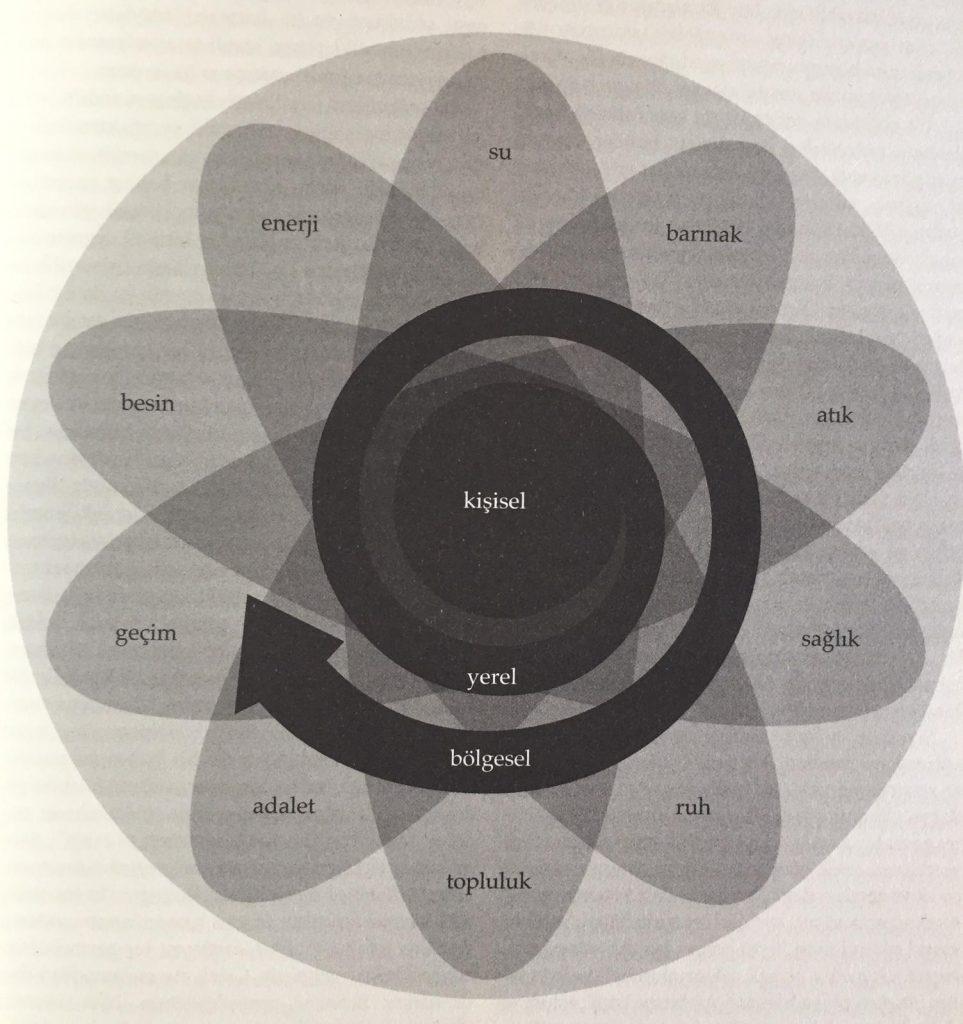
When you say what are the practical areas of permaculture, I want to say everywhere and every moment, but  with the concern that it may be very abstract and incomprehensible, I would like to draw attention to David Holmgren’s “Permaculture Flower”. Each component in the flower can be functionalized in practice entirely depending on our creativity and how we want to live within the concept.

Permaculture Flower is adapted from Jonathan Woolson’s drawing, modified from David Holmgren. Each petal shows a basic human need.

What does permaculture mean to you in city life? How do we make this concept a part of our daily life?

I think “zone 0” is yourself, permaculture starts to settle in every area of ​​your life. A serious waste is generated in the cities we live in, at the same time, these wastes have the potential to turn into considerable resources. For this reason, I dream of being able to act together with institutions and municipalities and transform city life from within. Ankara Development Agency’s (Ankara Kalkınma Ajansı) studies and projects on this subject continue. In recent months, we attended the “Introduction to Permaculture Training” presented by Taner Aksel with Sevecen. We talked about “what can be done to improve our cities” and talked about the support we can offer. The development and proliferation of permaculture works fill me with hope.

I believe that it is very valuable to live in cities with as little waste as possible, recycled and upcycled. There are compost applications that can be done easily in apartments. In this way, it is possible to turn food waste into humus soil, so you have a wonderful soil and you feel good. Some kind of a way of connecting to the planet, I think. Apart from that, there are very good organizations. Getting together and collaborating with people is both easy and important in cities. It opens up a space where you can be a derivativer instead of a consumer. In food purchases, it can be bought directly from the producers as much as possible. When you change your food preferences, you can really feel the bodily change directly. In fact, there are so many methods of this practice when you decide to care for everything, living and non-living, you find yourself in endless options with creativity stripped of all theories.

Based on your theoretical and practical background related to the subject, what are you doing and what do you plan to do in the future?

We make “bokashi compost” at home and consume as little packaged food as possible. We strive to transform our shopping preferences in ways that I believe more connected to social networks and healthier. We make washing machine detergent and cleaning vinegar. I use vinegar, baking soda and sometimes soft soap for cleaning. I think the perfect trio is the solution for everything. I have learned it is possible to make soft soap at home from waste oils. We will try it soon. I use soap in the bathroom and vinegar as hair conditioner is great. İlkin and Sevecen care about me in terms of cream and fragrance because they make perfumes and creams. I use EcoFont Vera Sans when printing even in the office and I use less ink. These are the first things I can remember.

Nowadays, the desire to do a permaculture internship is very vivid for me, I want to come together with the people who spend effort for this and may increase my knowledge. Essen has some projects carried out for years in Izmir. They are trying to create a permaculture garden on their land in Foça. I want to create some time and help them because they have a lot of practical experience that I can learn from.

On the other hand, we intend to create a permaculture-based garden in the front garden of Hamleci Mansion. In the recent past, we have started to take concrete steps regarding our ideas. Our soil analysis has arrived and we will soon have the well water analyzed. Our ideas, sprouting over the years, are beginning to deepen their roots. I am at peace.

What have you learned from your mistakes until today? What are your recommendations for the beginners?

I suffered from my tendency to be pessimistic and looking from a limited perspective. I learned how valuable it is to be hopeful and to be aware that the problem contains the solution. I understood the importance of taking care of each other and saw what we can achieve in cooperation.

There are very nice tutorials, videos, resources and they are increasing day by day. In fact, everything starts with increasing individual and environmental awareness as well as connecting with each other and with ourselves. Thus, our way of handling of the world becomes fun, constructive and sustainable.

Ayşe Yayla

Interviewer: İlkin Taşdelen

Translation from Turkish: Tevfik Hürkan Urhan

Let’s Go to Cappadocia: Hamleci Mansion, its History, Evolution and Influence

If Ayrancı is a shining spot on our inner world maps, Hamleci Mansion in Ürgüp is one of these luminous spots. For many of us, all these spots are the places where the feeling of being a community and the taste of being together penetrate our minds and hearts. While these vibes are transformed into Ayrancı-Neukölln Dolmuş magazine, we continue our journey to Cappadocia and then to our stop in Ürgüp, Hamleci Mansion. In this article, we want to try to explain how Hamleci Mansion has come to this day and where it goes. So, we want to go on a mini journey together.

Ürgüp is a place where the fabulous nature of Cappadocia survives, and the mansion is a place where the historical traces of the region can be followed. The famous fairy chimneys were constructed by wind and water giving shape to the texture formed by the drying of the waters in the history of active volcanoes. This geography, where different societies and cultures live, gives the feeling of an open-air museum that we can visit and see even now. Cappadocia, which Assyrians call “Katpatuka” and means “the Land of Beautiful Horses” in Persian language, is referred as the land of fairies according to a local legend.

Dear Yılmaz, who has absorbed Cappadocia into his soul, says that those who come here cannot leave when they enter the right door. It is indeed so, the roots that pierce and hold onto the rocks are so strong that it is impossible not to feel. This is the reason why we have not been able to get enough of dreaming of going back to and producing together in these lands and the Hamleci Mansion.

Hamleci Mansion was built about 200 years ago by the Greeks living in the region. One day when we were interested in the maintenance of the mansion, we learned from someone who came to do a research on the old Greek houses of the region that, in Evangelia Balta’s book “Prokopi”, there is a photograph of the first owner in front of the mansion. With the combination of these information, the stories about the mansion began to merge one by one.

We learned that the first owners of the mansion were Greeks and when they had to go during the population exchange period between Greece and Turkey, the grandfather, nicknamed Hamlecioğlu, bought the mansion. Hamleci Grandpa, whose stories we had been trying to learn for a while, was Atatürk’s telephone handler. According to what is told, he did not speak much. He was highly respected by those who knew him, and was able to see his great-grandson while he was alive. At that time, we learned that Hamleci Grandpa’s own family, as well as tenant families and “Yoğman Ağa”, who was handling some of the works of the mansion, lived together in the mansion. Ürgüp was the most famous and developed region in Cappadocia at the time that Hamlecioğlu Dede and the generation after him lived.

Another feature of the mansion that is the subject of architectural research today is its wooden door. This door was painted green after Hamleci Grandpa went on his pilgrimage.

There is a garden on the right side extending from the old door. Once in the garden, there were horses in the barn, old fruit trees, a vegetable patch and an irrigation pool. This fertile garden, which has been neglected with the decrease of the residents one by one over the years, is covered with weeds and trees. Even a part of the house was destroyed by these trees and according to the stories, this destroyed part was quite magnificent. Apple trees, which were said to have at least ten varieties before, have left their places to the self-growing apricot and black elderberry trees as well as a walnut tree that is hanging from the neighboring garden.

 When you continue from the plain that extends from the garden to the mansion, you will reach the stone stairs leading to the courtyard. When you arrive the courtyard, you will see the old stone house, some parts of which are in the rocks, and the “yellow house” where the vine trees make a shade at the entrance. The courtyard, which connects the mansion and the yellow house, is in the shadow of the vines during the day and the stars and the moon at the night. According to Evangelia Balta’s book Ürgüp – Prokopi, the shape of these stone houses was determined by the rock on which they rest.

We can easily feel the natural fabric of Ürgüp in this wide area where there is a gazebo that overlooks the front garden. This mansion, which once hosted a crowded population, has sections that serve different purposes such as flour place, barn, sheep pen, tandoori, grape distillery.

When we returned to the mansion after fifteen years long abandonment, while cleaning, we discovered that there was a chapel carved into the rock between parts of the house. We think that this chapel may have inherited from the early times of Christianity. In the third century, Christians trying to meet their shelter and security needs in the Cappadocia region were able to protect themselves from the religious pressures of the Roman Empire by taking advantage of the structure of the region’s rocks suitable for carving. During these times, they continued their lives and religious practices in these safe areas. We think that the chapel, according to another assumption, may have inherited from the tunnels connecting the houses in the area.

The flour house between the yellow house and the mansion served as a cellar where cheeses, meats, vegetables and fruits were stored thanks to its location in the rock and thus keeping it cool even on hot summer days. There are two separate wells in the garden and under the “yellow house” where the tenants stay, and even the neighbors would come and take water from these wells. While there were two separate symmetrical stairs leading to the yellow house during the time of Hamleci Grandpa, today only one of them stands.

The place under the yellow house, which has an independent entrance and which we transform into a workshop today, was previously a sheep pen. The place that involves the tandoor and is used as kitchen is between the flour house and the sheep pen. This place is called “tafana” in the local language, and neighbors used to come to benefit from the tandoori. There was a grape distillery in the garden and grape molasses was boiled in large cauldrons through making fire.

Especially during Ramadan and during the holidays, the mansion was full of relatives. When grandfather was alive, they would come to kiss his grandfather’s hand. These meetings were used to lead to get 3-4 generations of the family together. Local dishes of the region were cooked for the arrivals. Hamleci Grandpa always sat on his cushion next to the wood stove in the left corner of “the room with stove”.

We have not even been able to open most of this place, some of which are in the rocks, and new rooms are linked from the other rooms. However, the never-ending features of the mansion and the fact that Ürgüp has a huge differences and great calmness compared to Ankara provides us the space we need to construct the projects we want to do.

You start carving each rock with a hole. To begin with, we decided to revive the wine culture, that is unique to Cappadocia but is hurt, within ourselves. For this purpose, last summer we had an attempt on winemaking in cooperation with our friends in the region. We have experienced winemaking in terms of the grape harvest, the crushing of the grapes, the correct maceration. During this process, we visited the wine room daily and talked nicely with wines. We are currently at the stage where the grape juices waiting in barrels and patiently waiting for them to become wine. 

In permaculture, there is a crop / harvest / benefit cycle. According to Bill Mollison, all kinds of useful outputs that come out as a result of the behaviors or operations of the elements in the system are the benefits in that system. At the same time, these benefits are theoretically unlimited. We chose this principle as our road map while we construct a life system we will create in Hamleci Mansion. While buying what we need from the areas we live in and from each other, we chose to diversify and increase what we can give. With the awareness that everything is possible when we come together, all kinds of benefits we have achieved – from creating a rainwater pond in the garden to enjoying each other and healing – has been our motivation. We were good for each other, when it was good for each other, we were good for our environment as well. There were times we worked hard for Hamleci Mansion, and also we camped together in magical landscapes. It can be said that we work in festival vibes. This is our biggest reward.

It is not an easy task to get Hamleci Mansion back on its feet. Its historical nature makes any kind of renovation difficult. Considerable amounts of financial resources are required for the restoration. We are currently writing a project to receive grant support. We dream of in Hamleci Mansion, there will be a gallery area, a suitable environment where we can host artists from different places, a garden kept alive with permaculture principles and a boutique cafe or restaurant connected with the products of the garden. We are open to any improvement of and contribution to these projects that we dream of together.

In fact, what we are aiming at is to build a life woven with the art of coexistence while providing a space to everyone to discover what they want to do and helping them bring their discoveries to this life. What we experience while doing this is, starting from our uniqueness, learning to be “the one” and reflecting this; accordingly, we reach a state of “being a collective one” formed by the coming together of “all the ones”.

We are sending you all the smell of potatoes and chestnuts on the stove from Hamleci Mansion and our journey with the dream of having a place where we can enjoy our existence and materialize our ideas by taking care of each other. Let us know if you come nearby!

Contact with the authors:

Sevecen Kaplan @sevconot

Esin Metin @kaplumbagamutfak

Ayşe Yayla @aysmayslay

Translated from the Turkish original by Tevfik Hürkan Urhan

Portrait of a Paintress from Paris to Berlin: Feryel Atek

Feryel Atek

Can you describe the main components of the aesthetics you have been constructing through your painting? What kinds of artistic, cultural, and social inputs have fed your style so far?

I  like to create an organic body of colors and shapes animated through dynamical, impulsive movements and more graphical, fine gestures. This body of textures, forms, and lines always end up evolving on its own, so that I become the tool of an energy that drives me. I think rhythm and vibration are a big component of my aesthetic, but also symbolic representation plays more a role in my work. From a young age, I wanted to create an aesthetic of my own, I had the conviction that it would bring me paradoxically closer to a certain form of universality. I really enjoy giving a form to an emotion, creating an archetype that is called by my unconscious. I like using the human figure as a recurrent pattern, muster because I think it has an endless source of expressivity. 

When I recall the origin of my style, I think first of my familial background, both of my parents are figurative painters. I spent my childhood visiting ateliers and squats in the late 90s, in Paris they were passionate about all forms of figurative representation from the Christ on the cross, to Enki Bilal’s comics, Japanese mangas, Asian and African masks and marionettes. I was really touched by this and already as a child started to build my own style, mostly graphical.

 I also have Amazigh roots, also called Berber by Europeans, an ancient indigenous folk present on all the North African territory that had an influence on my visual vocabulary.

Philosophy, anthropology, and more recently art therapy also have a strong influence on my style, the human condition and the plurality of her interpretation fascinates me as much as all kinds of spiritual and mythological representations that have been existing. 

How would you describe the aesthetic relationship between Berlin, painting, and yourself?

I came to Berlin over 7 years ago. The energy and the aesthetic of the city were so different and refreshing from my hometown Paris, where the architectural heritage of the last centuries wasn’t destroyed by the war like in Berlin. Berlin with its newborn urban landscapes gave me a lot of inner freedom and stimulation to create. The open spaces, the charm of the industrial raw architecture meeting the plentifulness of green areas and the light of the East.

 Berlin also gave me the physical space to paint on a larger scale. And of course, the Berlin scene with her variety of eccentric personalities chasing freedom of being and expression inspired me to fully embrace my individuality. Berlin is also the city where I gave birth and transformed as a woman, becoming a mother empowered my work and desire to go deeper in my painting practice.

Which painters do you think played important roles in the formation of your artist identity? Which art movements have had a significant impact on your art?

It all started with the old masters, I met in museums of all over Europe in my childhood observing Caravaggio, Da Vinci, Artemisia Gentileschi but also Schiele, Kokoschka, Goya, Hokusai, Bacon, Kahlo, Ousmane Sow, Bilal, the Surrealist all of those that invocated the human soul and condition with an innovative form transcending time and space. Also, art from other cultures and places had a big influence on my artistic construction.

textum Magazine

https://textumdergi.net

How would you introduce textum Magazine to someone who doesn’t know yet?

In order to address the starting point that brings together the team working in the establishment and preparation phase of textum Magazine, first of all, Middle East Technical University (METU in short; Ankara, Turkey), more specifically METU Political Science Student Club (SBT) should be mentioned.  When almost all of us were undergraduate students at different levels, we organized a lot of activities together. Reading groups, talks, workshops, symposiums… These events always meant more than just “academic activities” for us. Of course, it also had such a function, we were improving ourselves and each other academically; but what is essential is that we were organizing a solidarity, an “idea”. Therefore, SBT was always at the forefront for both the discussions of students’ representation and the problems related to the faculty as well as May Day. So we are, as a part of this community.

Rather than just being a “student community”, with the work we did together during the time we worked for SBT, it became for us a “school”, an “alliance” and a kind of “organization”, trying to mobilize its academic qualifications in favor of the laborers and the oppressed, seeing itself as an ally with those and believing in the unity of thought and practice.

It would not be wrong to see textum Magazine as the fruit of this intellectual togetherness.

Although it was METU and SBT, which brought us together as those who took part in the realization of textum, we can say our current composition that stretches across much more diverse backgrounds and experiences and, consists of a group of students and academicians. The textum team is predominantly students operating in the field of social sciences and fed by different schools / approaches of critical thinking.  In this respect, we would like to state that it is a team that keeps the discussion within itself constantly alive. In addition, this mosaic structure of the subjects of the textum is the characteristic that makes collective work even more productive. The main motivation for this team’s unity is prioritizing the critical thinking that puts social realities and problems on the agenda against the mainstream intellectual thinking. The raw material of the activities, that we have shared and been a part of over the years, is this critical thinking.

Hence, we can say that Textum is an intellectual exercise field trying to make a humble contribution to the motto of understanding and changing the world while taking some academic concerns into the account, but essentially affected and inherited by the practice of labor struggles. Also, it aims to contribute as much as possible to moving labor struggles one step further through working letter by letter.

What kind of problems, needs, goals, concerns, affections, motives did you have in the beginning and construction process of this project?

In fact, the answer to this question is closely related to the issue we discussed in the previous question. We think we need the critical thought and its organization as much as water, as much as air. We mentioned above a team that wants to take their earlier work one step further and pursue a search beyond these mentioned activities. Textum consists of a team that has a collective history and desire of working together as well as trying to think and produce by discussing and asking new questions. 

Knowing that such an activity will somehow continue its life and hoping it to continue growing, we wanted to establish this channel. This is a medium that we hope to be instrumental in sharing thoughts and productions with more people, circulating them more and bringing people together. You will notice that when we mention the team who took part in the establishment of textum, we are actually talking about a “generation” shared same space and time and also gathered around similar motivations. In this manner, the textum is also a “generation project” for us. In addition to our experience of working together, we started this project with our belief in emotional togetherness of our generation and its critical and intellectual energy. We wanted to establish a publishing platform that brings people together who shares similar problems and desires, and have similar perspectives in terms of thinking and producing to us. Moreover, we wanted to contribute to the circulation of intellectual products which are produced in this setting.  As a result of such a search, textum became actually the way “we have things to say”, too.

What kind of problems did you encounter until this point? And what processes did you experience and what kind of solutions did you develop to overcome them?

Obviously, approximately a year ago before we put the magazine into a concrete form, we had to hold meetings and we needed some discussions. 

However, regardless of the course of these discussions, it took almost a year for this project to materialize and finally exist, both because it required a considerable workforce and overtime to start its publication life as a magazine, and also many of us were experiencing some radical changes in our lives. In this context, some of the results of the Covid-19 epidemic in the form of remote working-staying at home and the need to understand and interpret what is happening in the world more than before due to the epidemic provides us a suitable environment for realizing textum and to put into practice what we have in mind for a while.

Since the beginning of the pandemic process, we had already communicated with each other and continued to follow approaches to the outbreak and its direct and indirect consequences both in academia of Turkey and the world. As a result, as a positive output of the pandemics process, the textum, which we planned in advance but could not implement due to certain problems, started its publication life in June 2020.

Of course, there were other problems we encountered during this period. Many articles in the scope of our first file, which we planned for release, had content that required one-on-one or collective meetings with people. In this context, we had to constantly conduct our meetings online due to the pandemic. It should be said that this situation creates some obstacles to our deeper consideration on the issues. Similarly, it should be said that all the meetings that should be held as a publish team are also held on online platforms. Although such online meetings have beneficial aspects in terms of overcoming spatial distances, it should be emphasized that these meetings are not as efficient as face-to-face discussions. So much so that we even have to do this interview over the internet.

We tried to find solutions to such obstacles and disadvantages by meeting face-to-face and exchanging ideas in groups in the conditions that allow outdoor meetings in summer months, despite not all at the same time. Thus, we can say that our second file, which could overcome the disadvantaged conditions of the first file, was created with a richer content in terms of intellectual depth. Of course, we intend to develop the studies in future files.

Finally, we have to say that we faced with some structural problems of online magazine publishing. The best known of these is some technical problems in textum’s database. To be more specific, we wake up some mornings that the texts on the site were distorted, their order lost and similar problems occurred. In addition, sometimes access to the website may be disturbed. In fact, as we mentioned above, these are the problems of online magazine publishing inherent to technological diffuculties. Fortunately, some of the backup processes we have done on time, helped us in such cases and such small but annoying problems can be overcome.

What have you found on the way until the magazine reached this point? What do you hope to find for the future?

This is a really good question. Perhaps the most important benefits of a magazine or a similar project are those have found on the way or the ones to be found in the future. From this perspective, we should say that the first (and perhaps the nicest) thing we find on the way until the textum arrives this point is new colleagues. We should say that the textum, whose foundations were laid at SBT events in METU, has made many people a part of this work since the preparation process. In this context, the Textum Assembly, which we created as soon as we started publishing, became an inspiring medium where new ideas were discussed, as well as a structure in which we feel the strength of our fellow travelers walking with us with its ever-expanding sum. We are very happy to find companions who share similar feelings, excitement and intellectual approaches with us.

On the other hand, with this work, each of us gained new interests and experiences. One way or another, a publishing experience is ours. We have to follow discussions in a wide variety of fields, read and evaluate receiving articles, and make translations and interviews. There is a diverse learning process in both content and form for us. In summary, we aim to progress towards a publishing practice that will become stronger day by day with our new colleagues and our deepening perspective. In this respect, we firmly believe that the progressive process will bring new gains in every aspect.

What kind of interactions did the magazine project  and its process create in your close circle? What kind of reactions did you get?

It would not be wrong to say that we have received positive reactions in general. Especially since the first file we published, we have received feedbacks, which encouraged and made us happy, from our academic community. In addition, we have received and published new articles from friends who are inspired by what we have done and who want to improve the textum with their work. The most important output of this process is that we have contributed to the organization of critical practice in the intellectual field. Especially with our second file, the criticism we directed to the university, as an institutional structure that we are currently in, has gained the appreciation from our many friends. They congratulated us on our courage and made us look to the future with more hope.

In what direction do you want to advance in the future? What goals do you have?

What we have produced in our short publication life so far and the feedbacks make us think that we are not doing a bad job in line with the goals we mentioned above. We want to continue to work and produce in this direction as well as more people to feel and contribute as a part of this medium. The inherent motivation for publishing and establishing a publishing platform is to circulate, read and discuss the products you produce. We see that we have reached a certain readership so far, that our work has attracted attention in different circles with increasing interest. Of course, as a very young, newly established magazine, we are at the very beginning of the way. Our hope is to ensure the continuity of this interest, to create more and to produce works that deserve this.

It is our greatest wish that those who have academic, political and social interests and concerns, and those who have words to say in this context, will contribute to this discussion platform that we are trying to establish. The doors of the textum are wide open to those who wish to contribute to critical social thought. This call is of course primarily a call for our own generation. Today, a medium where the young generation, worn and despaired by the social crises of our age, can express themselves, discuss and speak about the mentioned social crises has become more needed than ever. Therefore, creating and expanding these types of mediums is one of the main goals for textum.

When considered in terms of publishing activity, it is useful to remember the fact that current time directs us all to digital channels. The fact that printed publication is becoming an increasingly rare method to choose increases the interest in digital platforms such as textum. However, it would be wrong to think that digital publishing alone provides access to the reader. The quality of the work produced here becomes very important. Another main goal in terms of textum is to produce intellectually quality content. Therefore, when we talk about our future goals, we would like to emphasize that we want to ensure the collective continuity of our work and to increase the quality of the content produced.

What have you learned from the mistakes you have made so far? What would you recommend to those who want to do similar projects?

As we said before, this is a long journey, we are at the very beginning of this road, and we learn new things with every step we take. Maybe this is not a mistake, but we could do it without the one-year delay we mentioned. In this sense, if it is accepted as a “wish”, we say, if only we had entered into this business before. On the other hand, there are some difficulties that the work itself poses. Although we have worked together or separately in various publishing works, we learn how difficult it is to produce a compact and organized file. In this sense, we did our best not to make the mistakes, that we made in the first file, in the second one. We believe that we will gradually reduce these mistakes in future studies.

Do you have any calls for solidarity to overcome specific challenges regarding the project?

To what extent it is possible to call this “difficulty” is unknown; but one of the most important achievements for a magazine would be to create its own audience. In this sense, we always repeat our call to be more read and shared.

Any last words?

Thank you very much for your invitation. We wish you good luck in your work, too!

Interviewer: Tevfik Hürkan Urhan

Translated from Turkish original by: Tevfik Hürkan Urhan 

Solo Pájaros: “Birds Die, You Remember the Flight!”

From the depths of the heart, with brutal honesty, comes the sound of this volatile band. Inspired by the sublime flight of the bird, the music of “Solo Pájaros” brings to the stage the powerful joy of living. Their lyrics describe the sadness that often haunts the human walk with the desire to turn it into poetry capable of raising wings in every curious listener. If we were to let his music be carried away by the wind, it would have no certain whereabouts, but would travel without a flight plan, trying to reach all the places in the world. It would treat the small as something big. The darkness of the moon as the brightness of the sun. And the inevitable death as a flash of life.

Initially three of the band members (Trini, Alex and Jan) started playing at the beginning of 2014. Singing in constant movement in the trains of Berlin, Madrid and Barcelona. Two years later two new important musicians (Antonella and Uaio) joined the band. From there the constellation that nowadays conforms the band would be aligned. Two women and three men. Five musicians. Three strings. Two percussions. And five voices.

They give their musical support in various solidarity events. They toured festivals in Hungary and Germany. In the middle of 2016 Trini and Alex leave the band and two new members join; Sebastián Yaniez first playing electric guitar and charango. A year later Sebastián Rosales joins on drums, where the band changes the sound of the cajon for that of a drum kit. They record and mix their songs between the walls of their rooms. They film their own video clips. They write their own songs. They are not afraid to feel the fall in order to find the flight.

To listen another song of them:

Fuck the Shame Away!

Fuck The Shame Away
2020

Menstrual blood on paper

The name speaks for itself and should be taken literally. This is an invitation!
Is there anything in the picture making you flush? Anything in the picture related to shame for you? No? Great! It took me a while to get there – if I’m already there at all!

Personally, I see shame about hair, masturbation, and menstruation. It was the shame towards my menstrual blood that led me to make this painting.

I see the root to it in a thought I had long ago: “I have people licking me while I’m menstruating, but I don’t really have a clue what my menstrual blood actually tastes like, except for a few after-cunnilingus impressions when I got a kiss afterwards. And I remember a feeling of distastefulness coming up. And there it was: SHAME.

Fuck this! These people seem to accept my bodily fluid more than I do? I don’t want that! And then came the question: But how can I change that?


First Idea: By trying it, of course. So next time I got my period, I took out my menstrual cup, looked at it, dipped a finger in, and tasted it. Bloody, and ok actually. First step done.
Later on, I accidentally found a webinar about menstrual blood that turned out to be full of ideas on how to get a better connection with it. One idea that caught me was: painting!


So I bought some droppers at the pharmacy to store the blood of each day separately, and some time later I did the first painting.


Fast forward to the prephase of “Fuck The Shame Away”: I made a couple paintings until I needed to produce more paint, and then an interesting feeling came up: I couldn’t wait to menstruate! And, surprisingly, I felt productive just by lying around and menstruating. I love this!


And while painting, there was a completely bloody mess on the floor that didn’t even bother me much. That is a development I was looking for!

The few things I used to create this painting are: paper, my blood (each day of one menstruation stored in a different container), water, and a brush. The variety in colors is due to the different shades from day to day, and to the amount of water it is mixed with. After painting, the colors changed a bit over time. 

And for those who are wondering, it doesn’t smell – if I get really close and inhale deeply, I can catch a soilish smell.

Maria Landmesser